Coursebook Series

Smile Series

An English coursebook series for private elementary schools that nurtures solid foundations while keeping children’s excitement at the center

View catalog (PDF)
Smile Series

Smile is an elementary English coursebook that helps children living in Japan build the ability to express themselves in English. Building on Japan’s Fundamental Law of Education and the Course of Study, Smile carefully chooses vocabulary and expressions and presents them in an order and style designed for natural learning.

Since the texts launched in 2014, we have enriched the content every year and created supporting materials and print resources in response to classroom needs. As values around society and education continue to shift, Smile will keep evolving—holding on to what matters while actively embracing new ideas and methods.

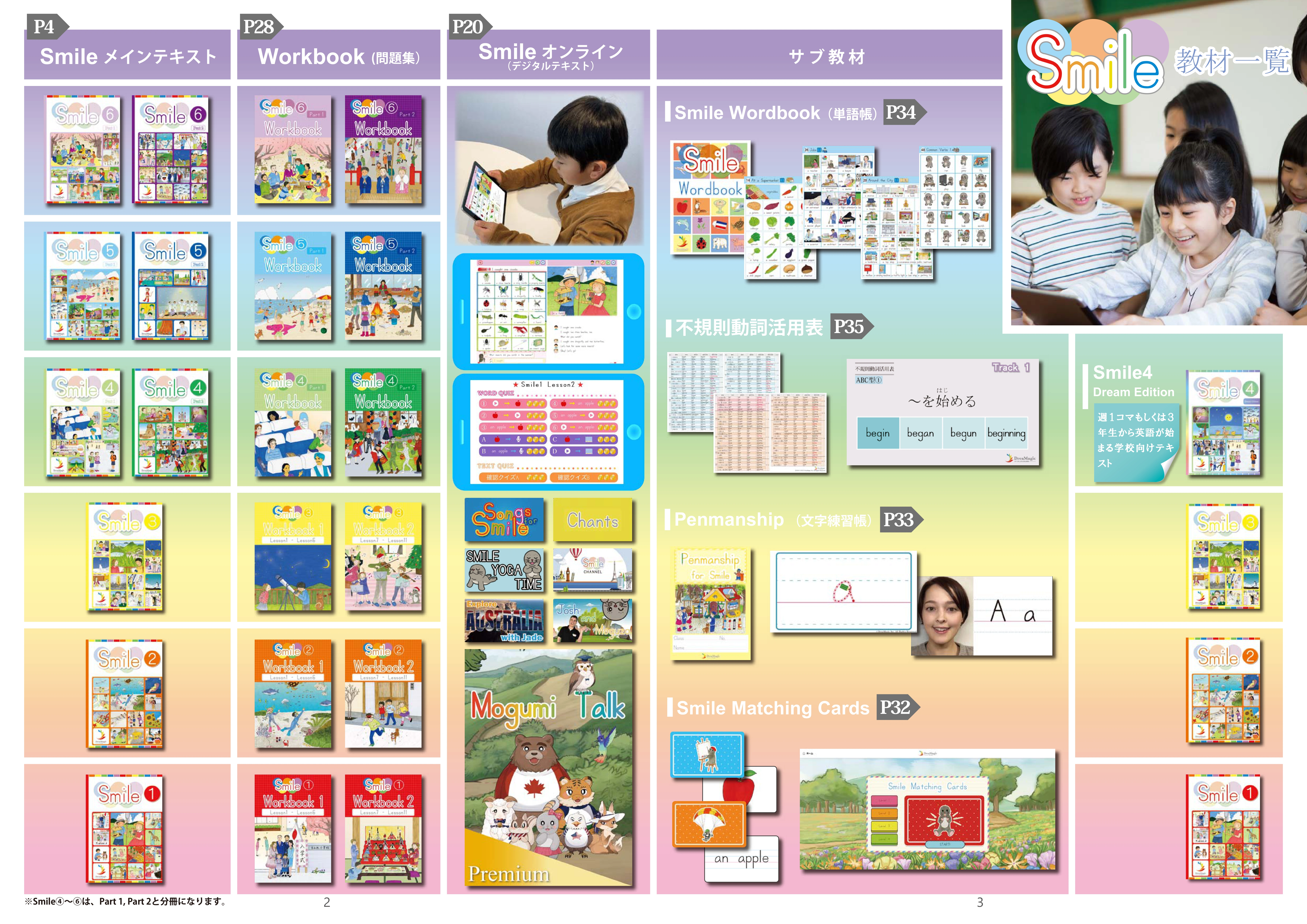
Lineup

Lineup

* For schools that begin English in grade 3, Smile 1–4 Dream Edition is recommended.

Four features of the Smile series

Here are four features that help schools make the most of Smile and deliver high-quality English education.

01

Story syllabi that make children want to listen and read

Smile uses an original story syllabus, weaving target language into long-form stories children want to follow. Characters such as Taku and Lucy grow with learners from Smile 1 through 6. Upper-grade stories often include Japanese culture and customs, helping children re-express ideas about their own lives.

02

Rich illustrations and a sense of the seasons

Abundant hand-drawn illustrations support comprehension, and lessons align events and clothing with the intended season. Smile 1–2 stories can be roughly understood from pictures alone; from Smile 3 onward, non-verbal cues gradually decrease so attention shifts to language itself.

03

Many free services that support teachers

Adopting schools receive teacher’s guides, flashcards, mini vocabulary tests, activity sheets, stickers/puppets, uniform illustrations, poster data, the DreaMagic Style font, and teacher access to Smile Online Premium—free of charge.

04

Rich supplementary materials that reinforce the texts

Workbooks, card sets, handwriting books, vocabulary books, irregular-verb charts, and more support learning at each stage. Generative-AI English learning is offered through the related service Mole Town®.

Curriculum highlights

A curriculum that sparks awareness for elementary learners in Japan

Smile aims to build the foundation for children living in Japan to express themselves in English. One key to that goal is a systematic curriculum and lesson design that promotes awareness. The curriculum is organized into Smile 1–3 (Part 1) and Smile 4–6 (Part 2). Part 1 focuses on basic vocabulary understanding and retention, and familiarity with core expressions. Part 2 focuses on organizing basic expressions using known words and deepening understanding.

Smile also presents an original grammar sequence that considers Japanese children’s mother-tongue acquisition order and cognitive development—distinct from the typical order in junior-high English classes.

For example, Smile 1 begins with “How many…?”. Junior-high courses often start with “What…?”. Counting comes first because, for first graders, counting visible objects is clearer and easier to grasp than the more open-ended What.

With this approach, by the end of the series children can experience expressions up to junior-high graduation level (Eiken Grade 3) without undue strain.

Smile 1–3 include over 900 headwords; the full series exposes children to over 3,000 words!

Knowing many words is essential for smooth communication. Across Smile, children encounter more than 3,000 words—about four to five times the 600–700 words recommended in the elementary Course of Study. These are everyday words, not abstract vocabulary typically taught later, so they matter greatly for self-expression.

Becoming familiar with longer texts in elementary school also matters. In Smile 6, children listen to and read passages of about 350 words to build gist comprehension.

<Receptive and productive vocabulary>

The Course of Study calls for developing both receptive and productive vocabulary so learners can communicate effectively with a rich lexicon.

Receptive vocabulary is words understood when listening or reading—linked to listening and reading skills. Words whose meaning is clear when reading a book or hearing someone speak are receptive vocabulary.

Productive vocabulary is words used when speaking or writing—linked to speaking and writing. Words used in conversation or essays are productive vocabulary. Both are needed for communication; because productive vocabulary is generally included within receptive vocabulary, experiencing many words first is important.

Smile series curriculum overview

Part 1 (Smile 1–3): Basic vocabulary understanding and retention; familiarity with core expressions

SmileGoalTotal wordsUnique wordsExpression examples
1Raise awareness of number2,457593How many…? / There is…. There are…. / What…? / Who…? / Where…? / Prepositions & demonstratives, etc.
2Understand concepts of time (past, present, future)2,817699When…? / What time…? / will & past / Imperatives / how & can, etc.
3Understand differences tied to person, case, number, and tense3,283834Pronouns / 3rd person singular / would like to… / want to… / be going to… / if / Which…?, etc.

Part 2 (Smile 4–6): Organizing basic expressions with known words and deepening understanding

SmileGoalTotal wordsUnique wordsExpression examples
4Organize wh-questions and answers and deepen understanding6,2591,209Who / What / Where / What time / Whose / Which / Progressive / on [days] / from…to…, etc.
5Organize advanced expressions in simple sentences and deepen understanding7,0491,315When / How many / How+adj / Past / 3rd person / Gerunds / will / be going to / Comparatives & superlatives, etc.
6Organize advanced expressions in compound/complex sentences and deepen understanding9,9761,553Passive / to-infinitive / Subordinating conjunctions / Direct & indirect speech / Relatives / Perfect, etc.

Main texts

Smile 1–3 (lower grades)

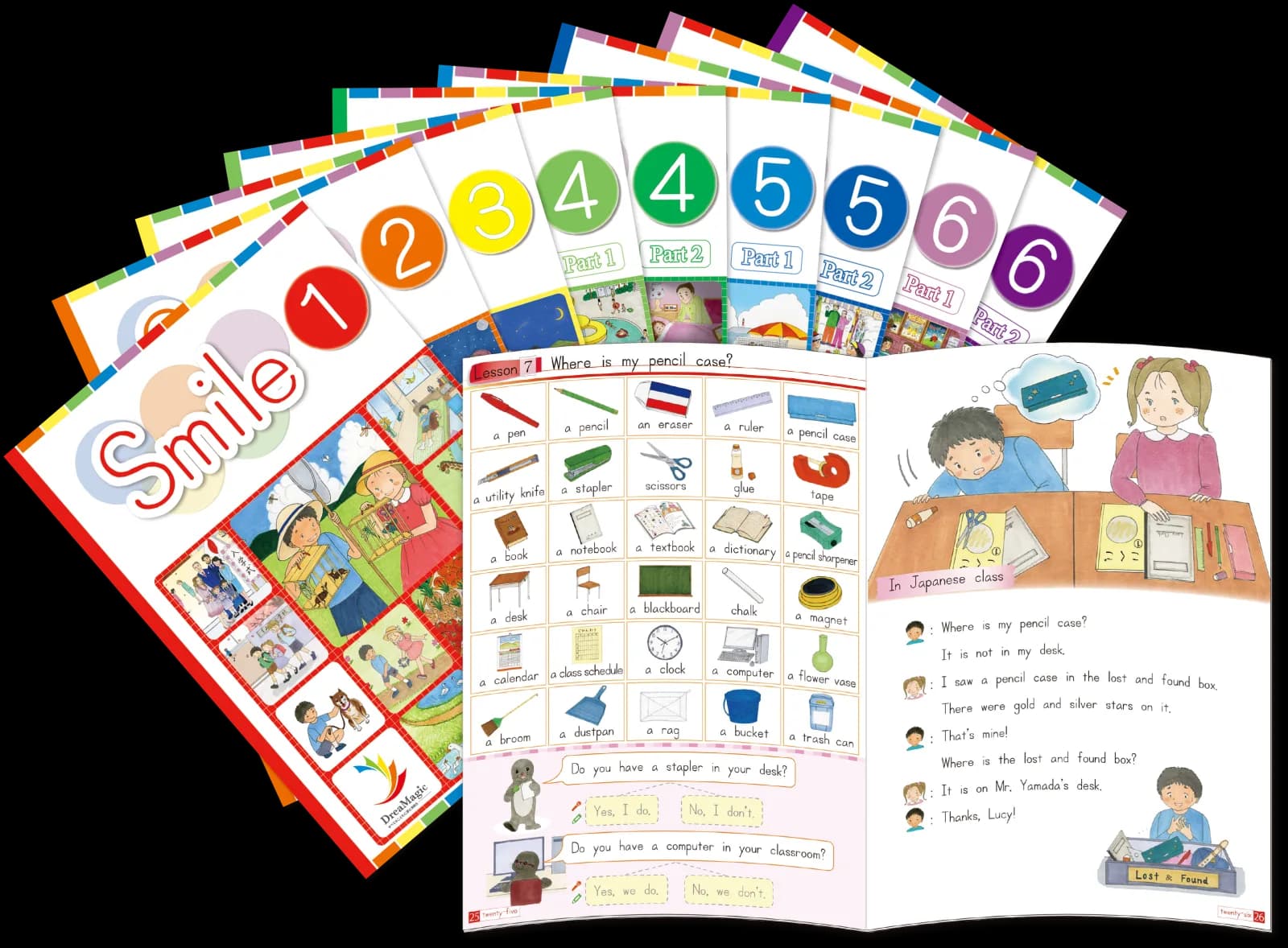
Each book has 11 lessons of 4 pages, centered on vocabulary learning and familiarizing children with number, tense, and person through stories. The year typically follows a 4–4–3 lesson distribution by term, with seasonal stories.

Smile 4–6 (upper grades)

Each book has 11 lessons of 6 pages, split into Part 1 and Part 2. Learners review earlier language and take on richer content through stories, with CLIL-oriented openings and spiral recycling of known words.

Smile Online

Smile Online (digital text)

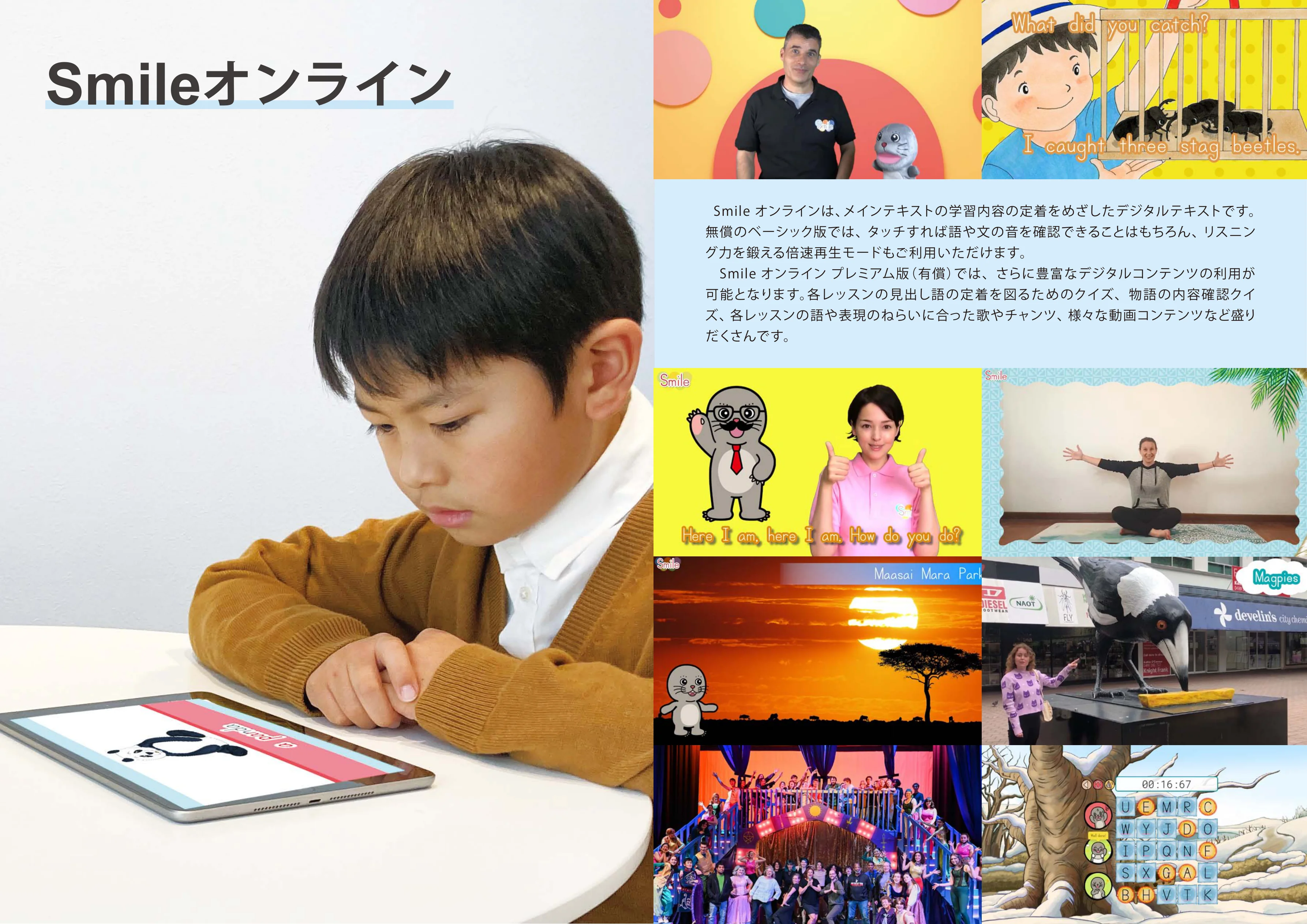
Smile Online helps consolidate main-text learning. Basic lets learners tap words and sentences for audio (including 1.3× speed). Premium adds vocabulary quizzes, songs, chants, and a wide range of video content.

Smile Online (digital text)

Basic / Premium key features

FeatureBasicPremium
Audio playback, 1.3× speed, word/sentence playbackYesYes
Vocabulary learning videos (Smile 1–3)Yes
Story comprehension quizzesYes
Character buttons (Smile 1–3)Yes
WORD QUIZ / TEXT QUIZ (incl. pronunciation & spelling)Yes
Videos such as Songs for Smile / Yoga Time / ChantsYes
Student learning history (for adopting schools)Yes

Supplementary materials

Smile Workbook

Text-aligned workbooks from basics to application. Levels 1–3 use a 6-page lesson format (2-book sets); levels 4–6 use 10 pages per lesson and include services such as Letter to Ms. White.

Smile Matching Cards

30 carefully chosen pairs (60 cards). Through play, children learn sound, meaning, and spelling. Adopting schools receive four levels of quiz audio free of charge.

Penmanship for Smile

A full-color handwriting book with letter formation, minimum phonics, and writing animations. Adopting schools also receive font data and posters free of charge.

Smile Wordbook

An A5 vocabulary book collecting Smile 1–3 headwords plus many everyday words. Adopting schools receive adjective/verb poster data free of charge.

Irregular verb chart set

120 irregular verbs grouped by pattern, with an audio example booklet and clear file. Practice and pronunciation-challenge sites are added to Smile Online for adopting schools.

Pricing & quotes

Please ask your sales contact about school supply pricing for Smile materials. We can prepare a quote on request.

If your school or educational institution is considering this material, please contact us below.